
A Game for the Many
The biggest crowd ever to watch a soccer match

Like a lot of people, I’ve been watching the World Cup lately. Despite all of the shameless profiteering and corruption that preceded it, the tournament has been compelling.
Most of the games have been close and unpredictable, but it’s almost as fun to watch the fans from different countries as it is to watch the players. There have been so many shots of something we see less and less these days: pure, spontaneous human emotion. It’s beautiful to watch fans losing their minds over a win, and heartbreaking to watch despair set in for fans of the losing team.
As I’ve watched the camera pan across sad fans, I’ve often wondered how many of them were thinking about how much they paid for those tickets just to watch their team lose. After all, many of the fans in these stadiums have paid thousands of dollars for a single game ticket. Only the wealthy and those comfortable with imprudent levels of credit card debt can attend.
The prices are one reason that FIFA and their partners are making so much money on this tournament. The other reason is that they have a lot of tickets to sell at such high prices. Almost all of the stadiums are NFL venues with capacities of 60,000-80,000, which hold 20,000 to 40,000 more people than soccer stadiums that have hosted World Cup games in the past.
If you go back further in history, however, you’ll find a few games with attendances that boggle the modern mind. The 1950 World Cup final between Brazil and Uruguay, for example, packed at least 170,000 fans into the Maracanã Stadium in Rio de Janeiro. This was the era before assigned seats in big sections of stadiums. Tickets were cheap, the game was for the masses, and the masses came in huge numbers.
That final at the Maracanã is often cited as the stadium event with the highest attendance. But that’s only because the organizers were able to count the attendees. The largest crowd to ever watch a soccer match probably assembled on April 28, 1923, to watch Bolton Wanderers take on West Ham.
Let’s take a moment to situate ourselves in time. By 1923, the horrors of World War I were in the past, but not that far in the past. The grief that so many people had suffered was still fresh, and society was still recovering from the shock of the experience. A postwar economic boom was slowing down, and people were dissatisfied with their political leaders. At the same time, it was a hopeful moment; the country was becoming more democratic and opportunities for leisure and recreation abounded.
It was in this atmosphere that the government unveiled Empire Stadium (later renamed Wembley), built for the British Empire Exhibition of 1924. The 1923 FA Cup final would be its first big event.
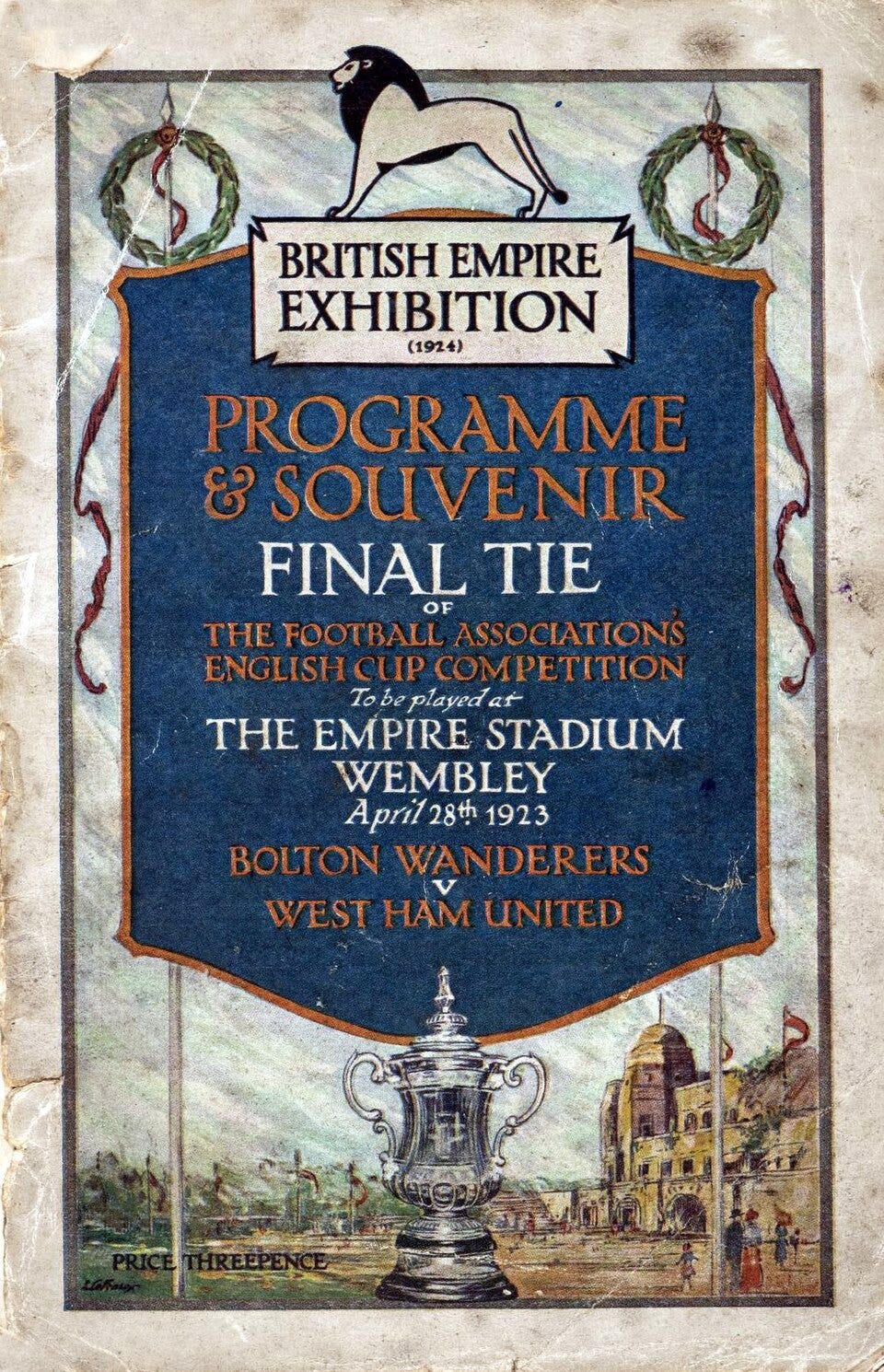
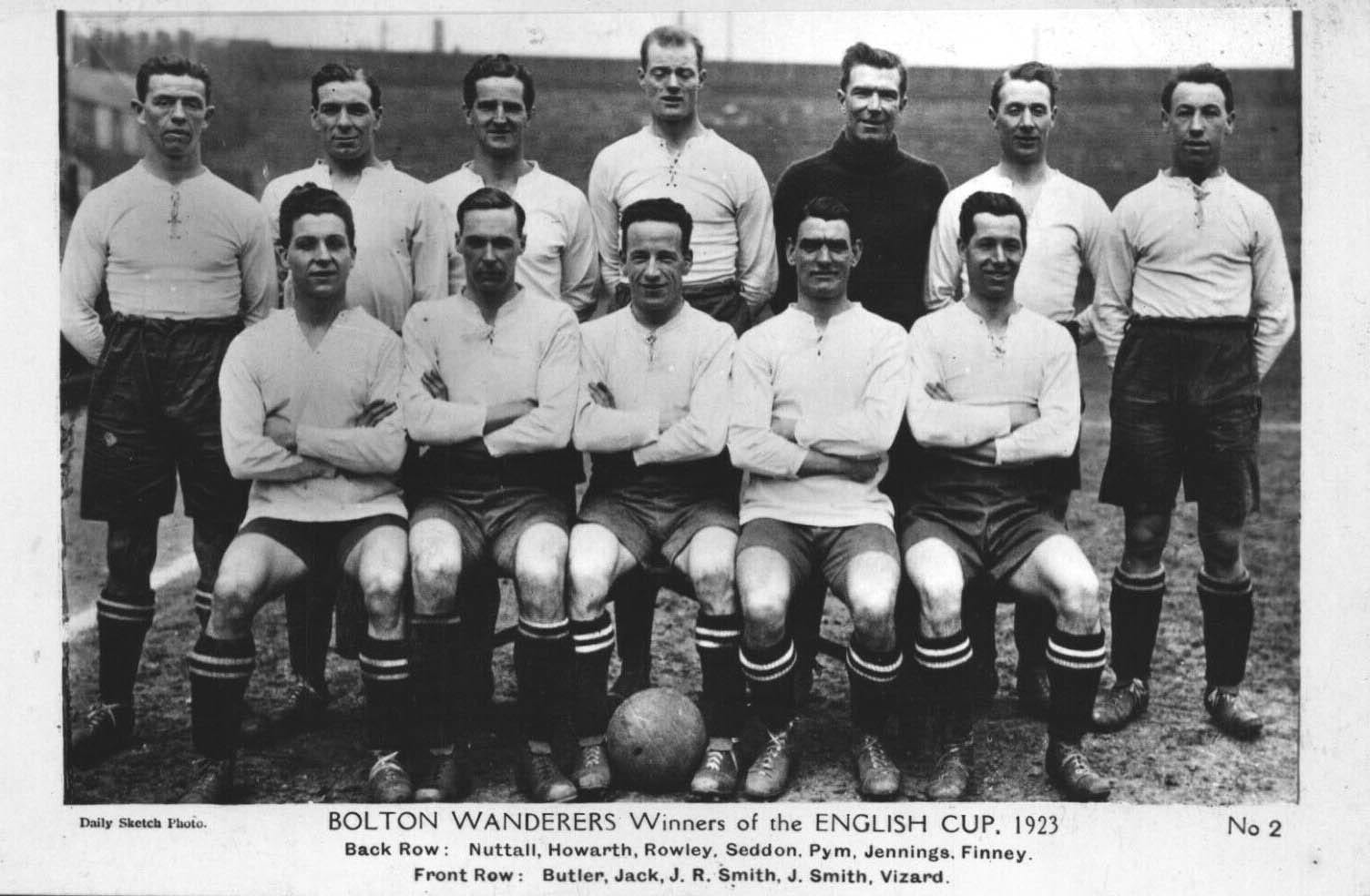
Officials that day expected 115,000 attendees to watch the favorites (and eventual winners), Bolton:
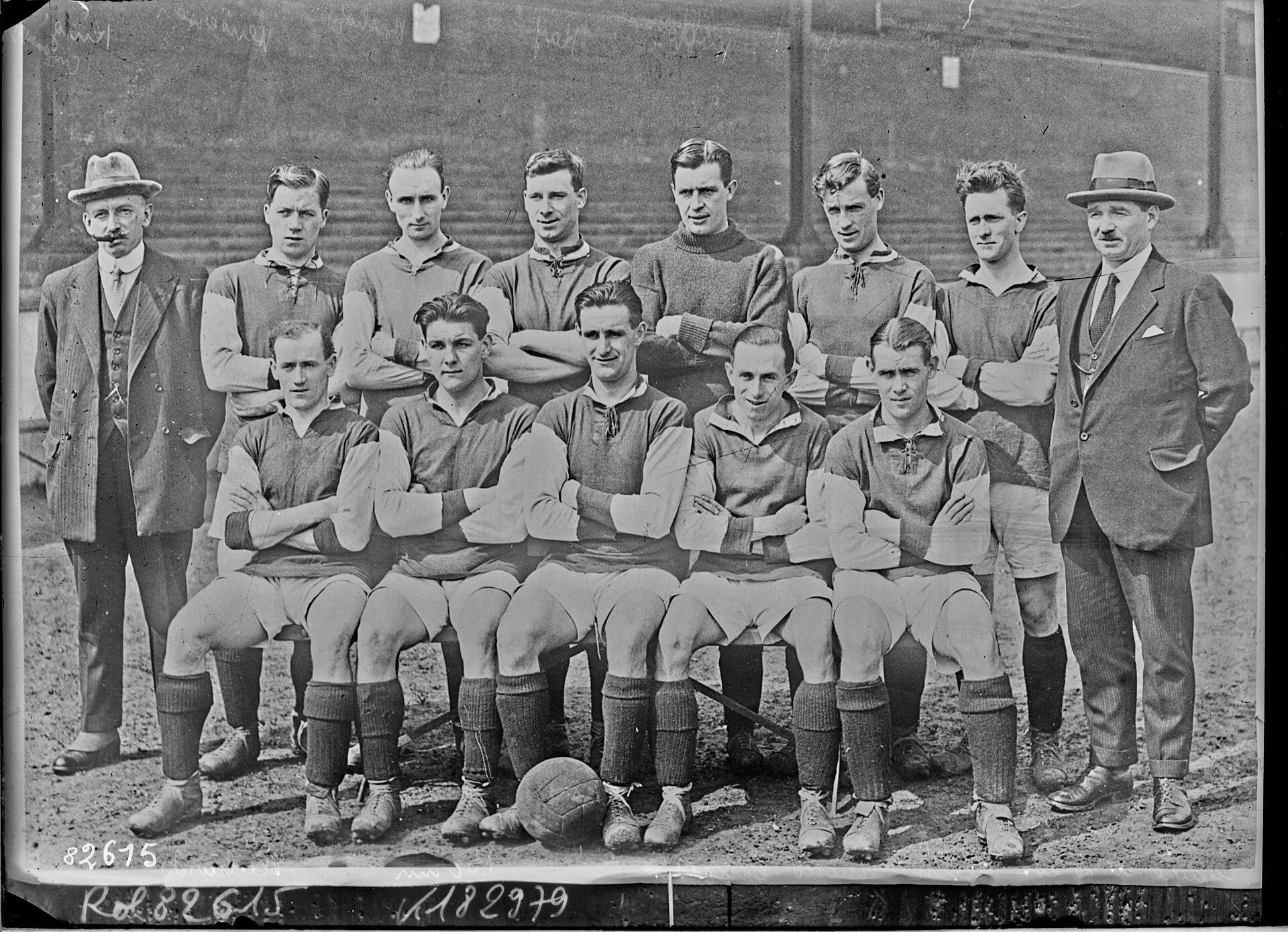
Take on the underdogs, West Ham:
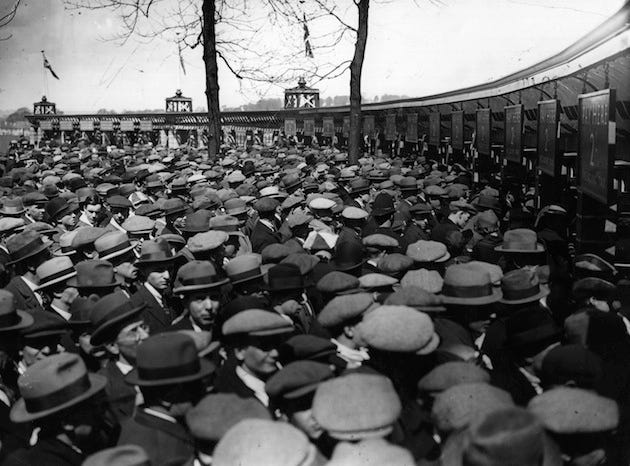
Congrats to Bolton, but the sporting contest was secondary to the human spectacle of the event. Hundreds of thousands of spectators went to the stadium that day to see if they could get in. Perhaps 300,000 actually did. They swarmed the turnstiles:
The police and stadium staff were soon overwhelmed. People jumped turnstiles and climbed girders to get in. Some stadium staff gave up and simply let people in. There were far too many bodies to fit in the stand, so the fans spilled onto the field:
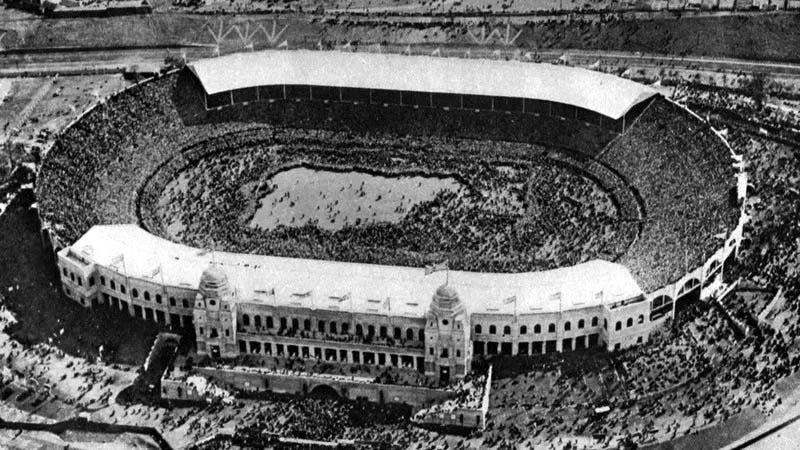
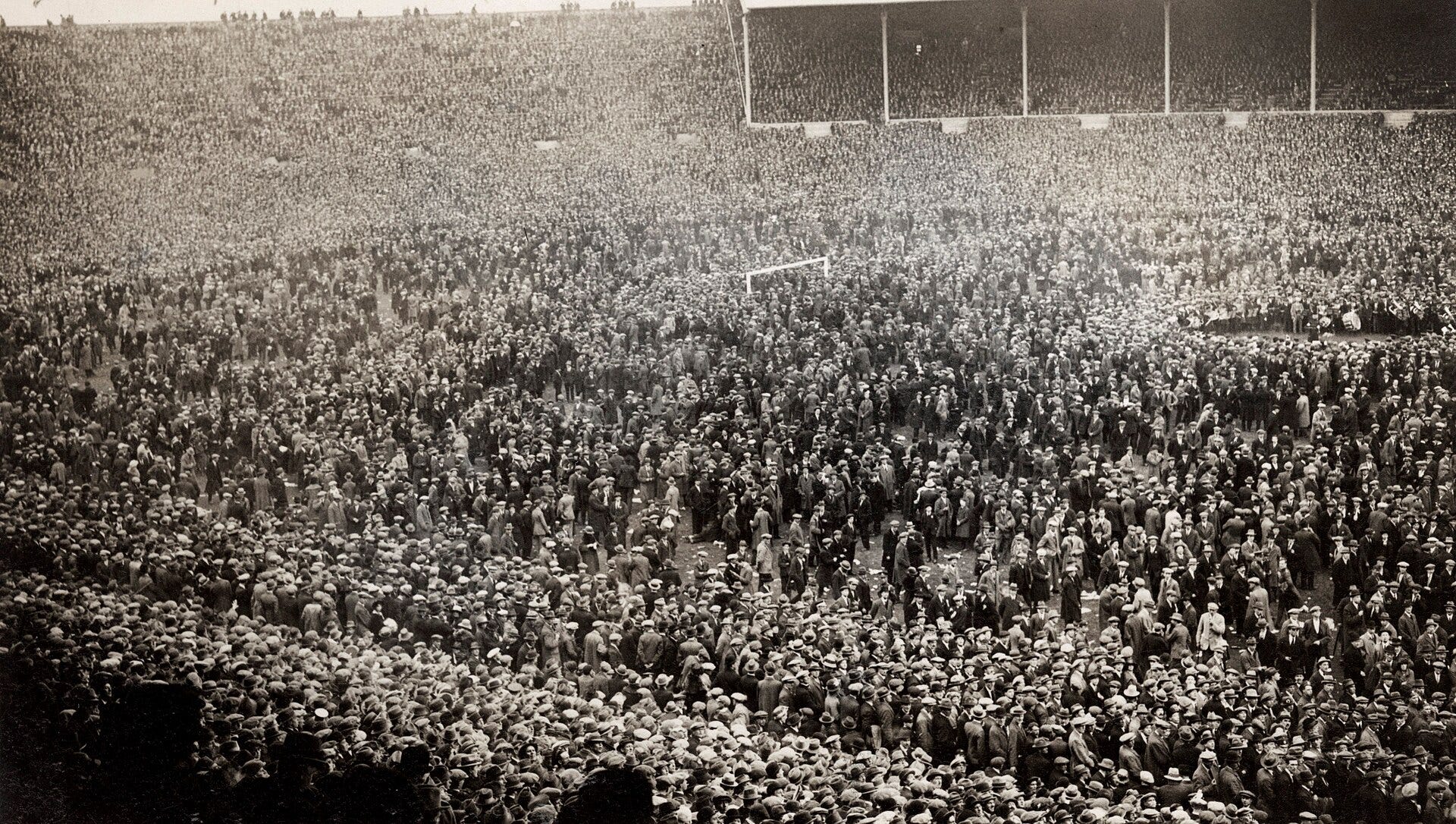
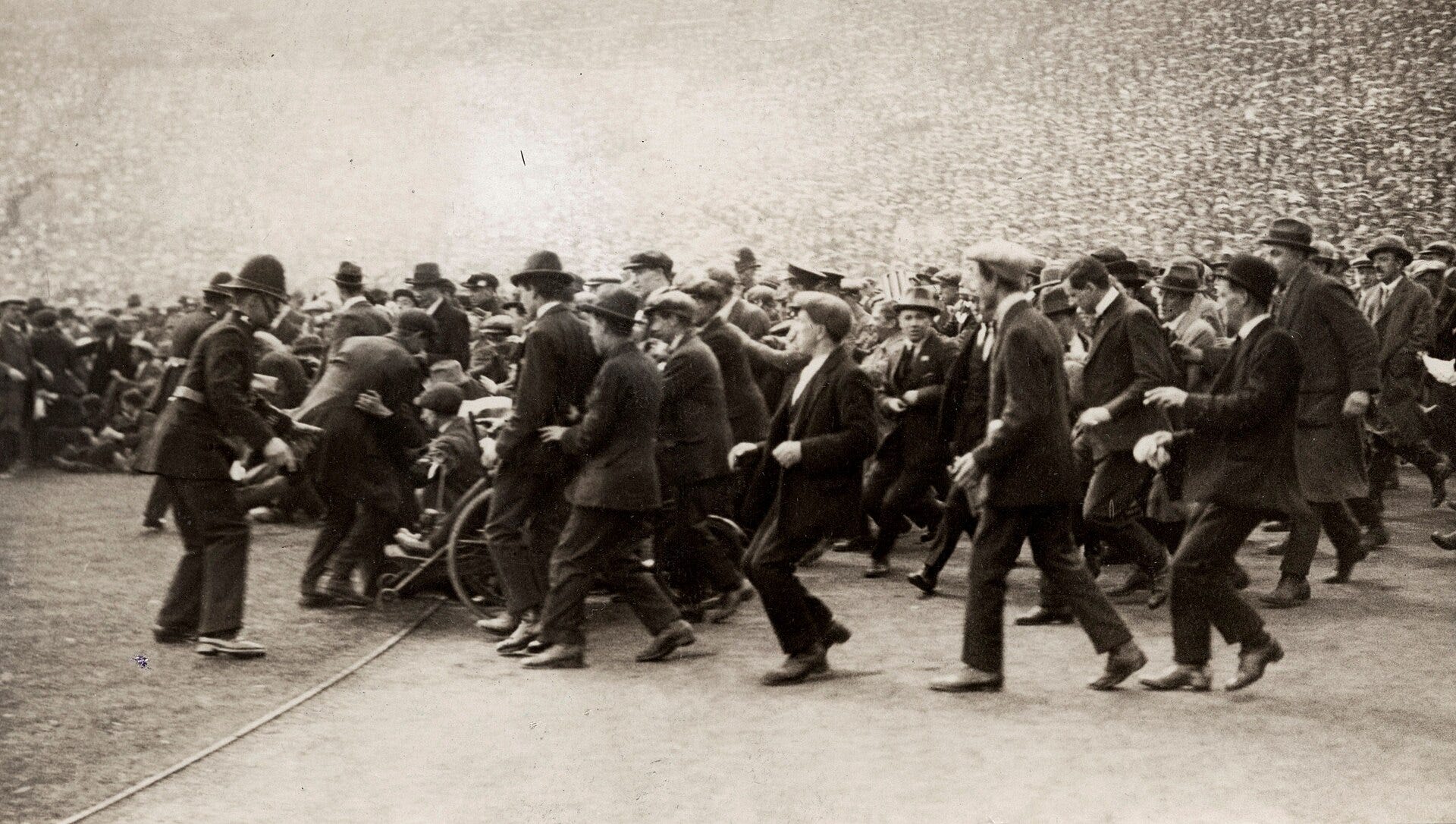
The clock ticked toward the scheduled 3 pm start, but it seemed impossible that a game could take place under these conditions. King George V was expected (he was supposed to hand the trophy to the winners), but no one knew if he would actually turn up to such a chaotic situation. He did, 15 minutes before the start. Here, he surveys the crowd:
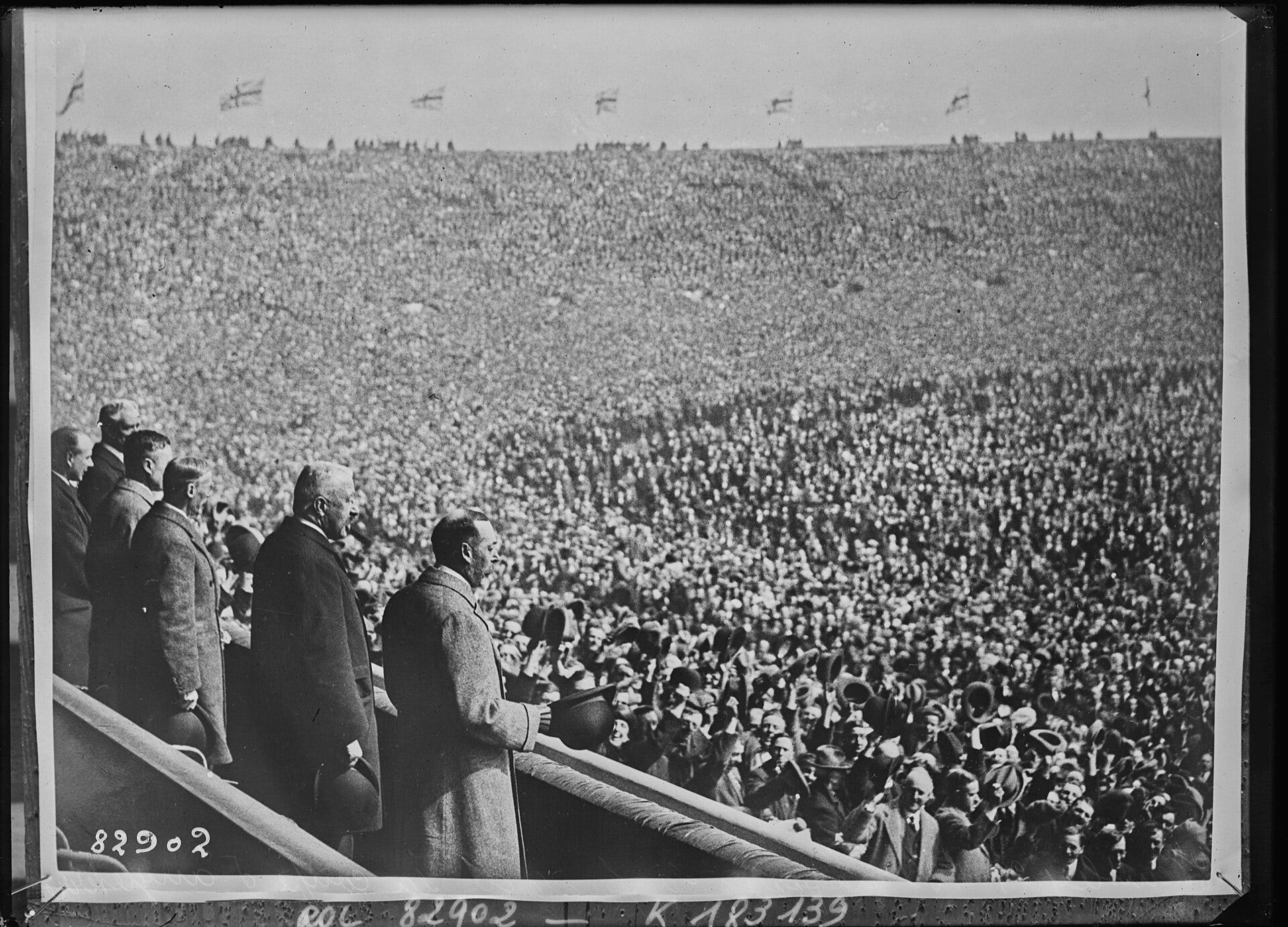
Now the only problem was the tens of thousands of fans on the field. Someone would have to convince them to move. The players came out, but they only attracted handshakes. Police officers tried, too, but they were outnumbered. It wasn’t until some mounted officers emerged, visible to everyone on horseback, that the crowd began to respond. Some people call this game the “White Horse Final” because of a famous picture of an officer on his horse (named Billie, really colored gray) parting the crowd:
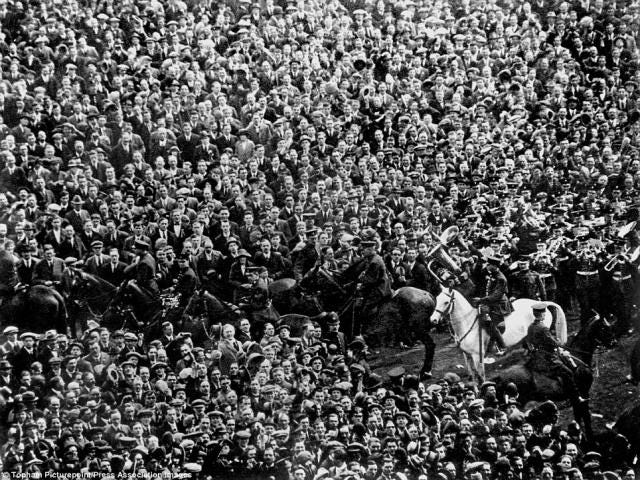
This worked, eventually. People locked arms and managed to push their fellow fans back beyond the lines:
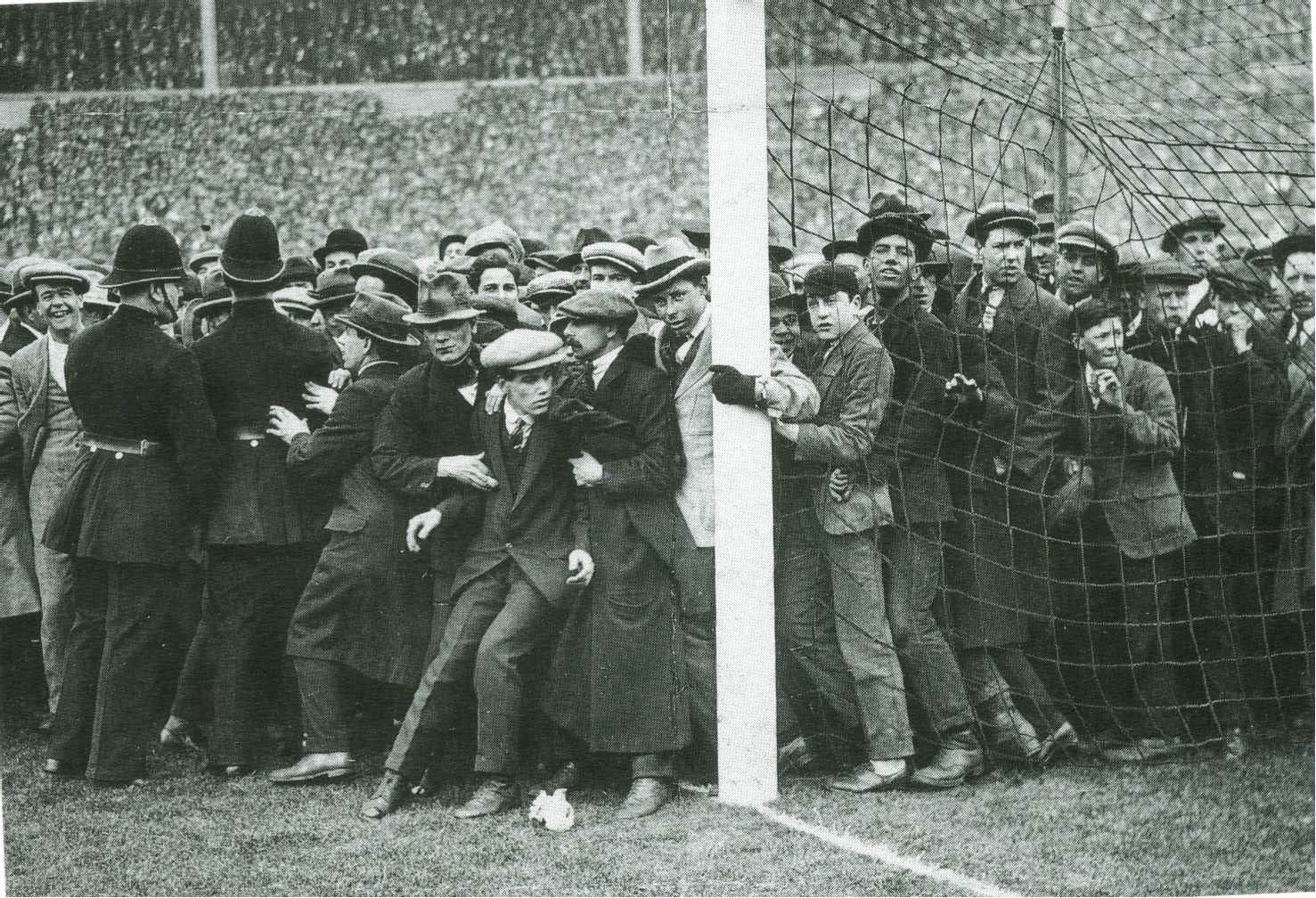
The game finally started around 3:45. It was an unremarkable contest (Bolton won 2-0) played in remarkable circumstances. Players running down the line had to watch for stuck-out legs. The teams couldn’t find a path back to the locker rooms, so they took a short break for halftime and just kept playing.
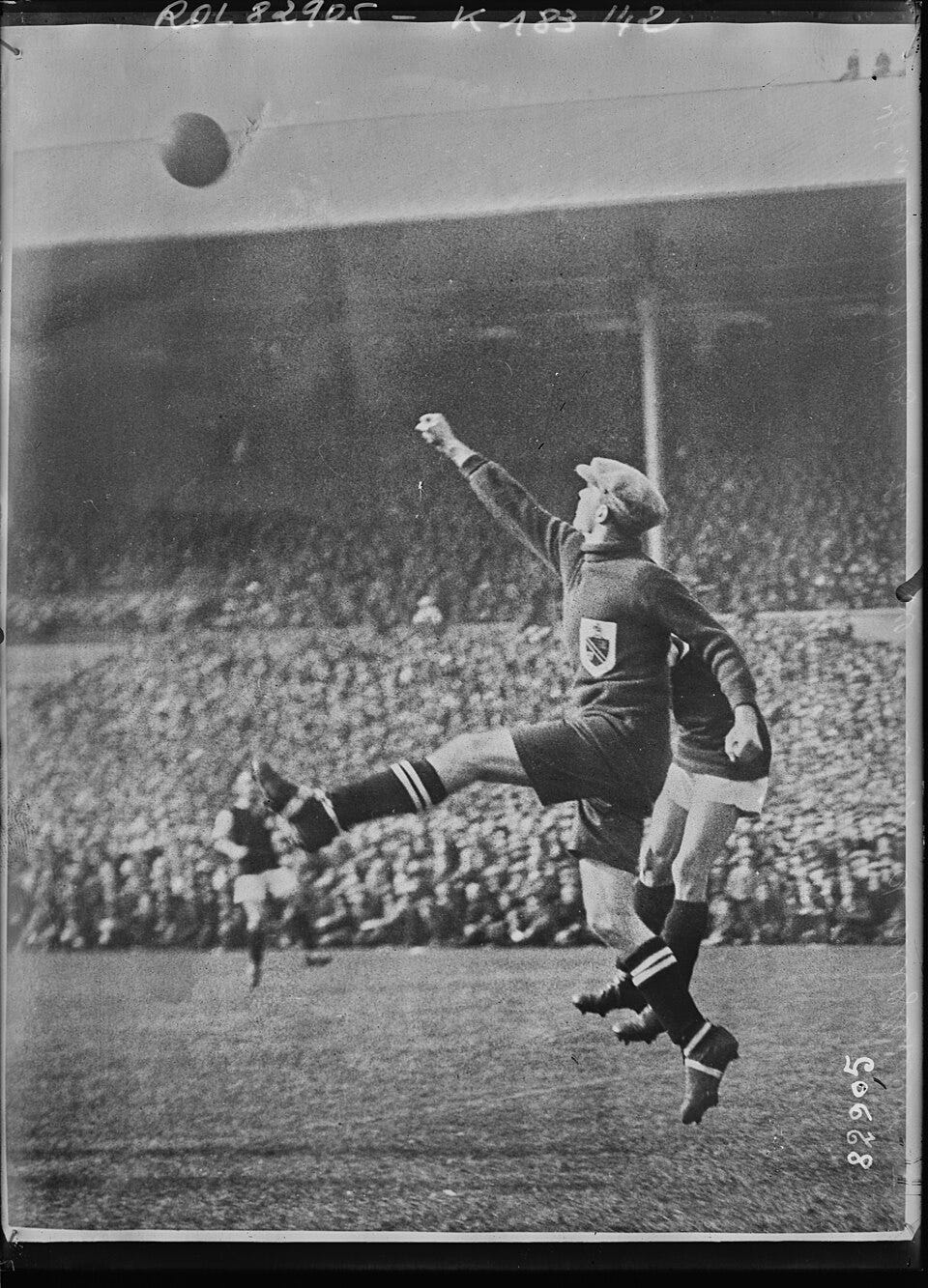
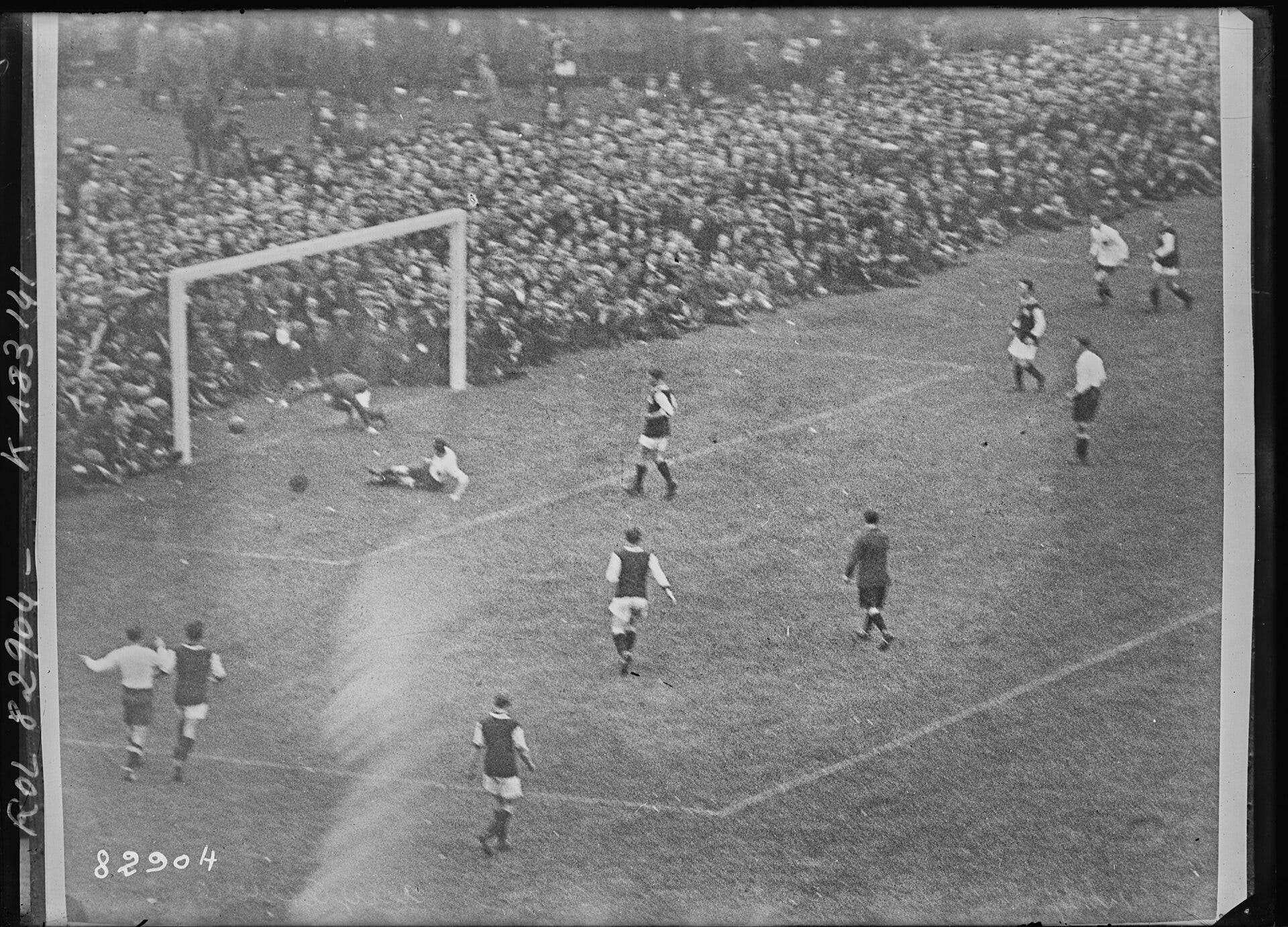


_de_West_Ham_united_(debout,_de_g._%C3%A0_d.)_King_(manager),_Henderson,_Bishop,_Kay,_Hufton,_Young,_Tresadern_(assis,_de_g._%C3%A0_d.)_Richards,_Brown,_Watson,_Moore,_Ruffell_-_(photographie_de_presse)..._-_btv1b53103005r.jpg)


_Wembley,_28-4-23,_la_foule_%C3%A0_la_finale_de_la_coupe_d%27Angleterre_(de_football)_-_btv1b53105564c.jpg)


_Wembley,_28-4-23,_finale_de_la_coupe_d%27Angleterre_(de_football)_-_btv1b53105563x.jpg)
_Wembley,_28-4-23,_finale_de_la_coupe_d%27Angleterre_(de_football)_-_btv1b53105567q.jpg)
The “White Horse Final” was far from perfect. Perhaps 1,000 people were injured in the crowd, and the event led to more thoughtful crowd-control and safety measures. The players seem to have been unhappy (a West Ham player, down 2-0 in the second half, asked the referee to call the game off). Nevertheless, it christened the stadium as a temple of soccer (a new Wembley replaced the original in 2007) and sparked some pride among the British public. People felt pride that the public and the police had handled the situation so peacefully. What could have been an ugly tragedy was instead a strange and wonderful afternoon.
I wonder if Gianni Infantino and his FIFA minions would look at these photos and shake their heads. Did it even occur to the organizers of the FA Cup to offer Pitchside Lounge Plus passes for $13,000, featuring champagne on arrival and a tailored culinary experience? And how could they miss out on the chance to sell $75 caviar-topped tater tots and other wildly overpriced food and drink?
The 1923 “White Horse Final” serves as a reminder of what sports used to be — entertainment for the masses where the presence of ordinary people mattered as much as the contest on the field or the profits made by the moneymen behind the scenes.
This edition of the newsletter is free to all, but I count on the kindness of readers to keep it going. If you enjoyed reading this week’s edition, there are two ways to support my work:
You can subscribe as a free or paying member, which gets you access to the archives and members-only posts:
Or you can “buy me a coffee” by sending me a one-time or recurring payment:
Thanks for reading!