
From Balloon Bombs to Predators
The long history — and moral quandaries — of military drones

You’ve probably heard the names of some of history’s great warships. Some of them, like the HMS Dreadnought, were simply massive and powerful. Others, like Horatio Nelson’s HMS Victory, were captained by legendary commanders. Still others, like the USS Enterprise (the aircraft carrier, not the fictional spaceship), were present at — and pivotal to — historically important battles (in Enterprise’s case: Midway, Guadalcanal, Leyte Gulf, and others).
The SMS Vulcano was none of those. It was a pretty basic paddle steamer operating out of Venice for the Austrian Empire in the middle of the 19th century. The ship and its crew found themselves in the midst of a Venetian rebellion against Austria in 1848; they escaped the city and then returned with reinforcements to blockade Venice later that year. All of this is pretty mundane stuff, and the Vulcano would be forgotten were it not for a strange distinction: the Vulcano was the world’s first balloon carrier.
Unable to mount artillery in Venice’s watery environs, the Austrian general Franz von Uchatius (who considered himself an inventor, working on movie projectors and metallurgy) decided to hit the city with explosives attached to paper hot air balloons. The Austrians tied a 30-pound bomb to each balloon, checked the wind, and let it go. Scientific American found the event notable, writing a snippet about it:
The Presse, of Vienna, Austria, has the following: ‘Venice is to be bombarded by balloons, as the lagunes prevent the approaching of artillery. Five balloons, each twenty-three feet in diameter, are in construction at Treviso. In a favorable wind the balloons will be launched and directed as near to Venice as possible, and on their being brought to vertical positions over the town, they will be fired by electro magnetism by means of a long isolated copper wire with a large galvanic battery placed on the shore. The bomb falls perpendicularly, and explodes on reaching the ground.
There’s not a lot of reliable information about this event (sources disagree about whether the Austrians launched 2 balloons or 200). It’s doubtful that the balloon bombs did much damage to Venice, and it seems that most of them blew in the wrong direction, missing the city entirely. But Uchatius claimed proudly that they inflicted “extreme terror” on the people of Venice.
The balloon bombardment didn’t make much of a difference in the outcome of the war. Venice surrendered to the Austrians at the end of the summer, and the pre-conflict status quo was restored. But the attack had opened up a new category of violence: it was now theoretically possible to attack your enemy from the sky using unmanned vehicles. The Vulcano had launched the first drone attack.
The seas of the world did not go on to bristle with balloon carriers. Nobody really tried to copy Franz von Uchatius’ innovation, probably because it hadn’t really worked. But the idea of an unmanned aerial attack came back into fashion during World War I.
The so-called Great War was the first conflict to seriously involve airplanes, which were mostly used for reconnaissance in the early years but later came to drop bombs on enemy targets. Flying a warplane was one of the most dangerous tasks in the war; the average pilot lasted six weeks before being killed. So militaries looked for ways to keep their pilots out of harm’s way.
Both British and American innovators got to work building unmanned attack craft. The Americans got closer to actually deploying one. They developed the Hewitt-Sperry Automatic Aircraft or “Flying Bomb,” which crashed too often in testing to be considered for warfare, and the Kettering Bug, which was made of papier-mache and powered by a $40 engine. The U.S. Army commissioned a few dozen Bugs from the Dayton-Wright Airplane Company, but never used them in combat out of concern that the aircraft would crash into Allied positions and kill friendly soldiers.
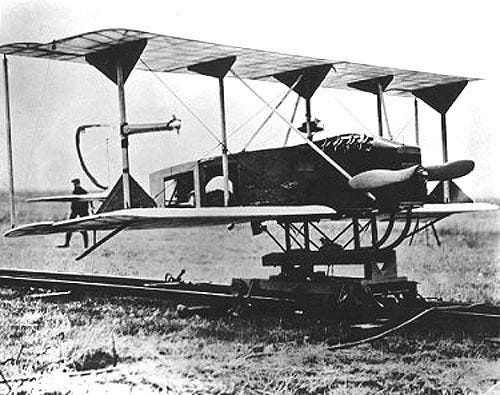

Between the wars, inventors built on the concept of these early drones. This next generation of drones was, like the “Flying Bomb,” designed to be relatively disposable, but as target practice rather than an offensive weapon. The de Havilland Company converted its popular Tiger Moth flight-training biplane into a drone called the Queen Bee. It was constructed of cheaper parts than its human-controlled counterparts and one of its cockpits was filled with radio-control equipment, meaning that it could be flown remotely or by a human pilot.
De Havilland built hundreds of Queen Bees, which were mostly used for anti-aircraft gunnery practice (this wasn’t as wasteful as it may seem: gunners would often adjust their aim so as not to destroy the planes, and they were made of wood so that they’d float if they crashed).
The Queen Bee is likely the reason that we use “drone” to refer to unmanned aircraft — when American companies tried to make their own versions of the Queen Bee, it was only natural to give them apiary names.
The English actor and aviation enthusiast Reginald Denny started up the Radioplane Company in Los Angeles, which made a wide array of target drones for the Army and Navy. His factory was also another kind of launching pad — an Army photographer snapped a picture of a beautiful young worker there in 1944. Her name was Norma Jeane Dougherty, the future Marilyn Monroe (the photographer’s boss, by the way, was Captain Ronald Reagan).


World War II saw more aggressive use of unmanned aircraft to attack enemies. The American TDR-1 was an “assault drone” designed to bomb enemy targets; it was controlled from another plane, and its controllers watched the drone’s dashboard through a television feed. The plane was used in the Pacific theater, but commanders generally found that manned aircraft were less of a hassle.
The Japanese took a decidedly lower-tech approach to their unmanned assaults on the United States. In 1944 and 1945, the Japanese Army launched almost 10,000 Fu-Go balloon bombs (made of mulberry paper and 20 feet in diameter) from Honshu, hoping that the winds would carry them across the Pacific toward North America. It was a hopeful attempt; only a few hundred of the craft made it to the United States, and they failed in their mission to start widespread wildfires because they hit during a rainy period.
Only one of the bombs killed any Americans: six people in Oregon who found one of the bombs and pulled it out of the woods. They were the only war deaths in the continental U.S. The Japanese government was apparently not surprised by the failure of the assault to change the course of the war — the attack had been undertaken mostly so that they could tell the Japanese public that they were striking American soil in retaliation for American bombings in Japan, and officials did not expect that it would really work.
Meanwhile, in the vicious air war over Europe, the U.S. military threw everything it had at German targets — including old bombers. When aircraft reached the end of their operational life, Operation Aphrodite emptied them out, filled them with 20,000 pounds of explosives, and flew them remotely at enemy targets.
The problem was that the planes could not make the entire flight under radio control — pilots would have to take off, set them on a course, and then bail out. This ended in tragedy for Navy pilot Joseph P. Kennedy, Jr., whose plane exploded prematurely and killed him. Joseph Jr. had been expected to follow his father into politics; after he died, his less-disciplined younger brother John was pushed into the family business. The program continued for a few more months, but did not achieve much.
On the day he died, Joseph Kennedy Jr.’s plane was heading toward the bunkers that housed the German V-1 pulsejets (and their V-2 rocket successors) that had been raining down on England for several years. The Nazis launched thousands of V-1s (which, unlike V-2s, had wings and flew horizontally like a plane) at London; their characteristic buzzing sound — which would cut out right before they made their deadly descent — became one of the scariest sounds in England during the later days of World War II.
For the next few decades, drones became more useful, but mostly as surveillance platforms. The Ryan “Lightning Bug” flew thousands of missions over Vietnam, photographing enemy positions from a low altitude that would have been too risky for a piloted aircraft.
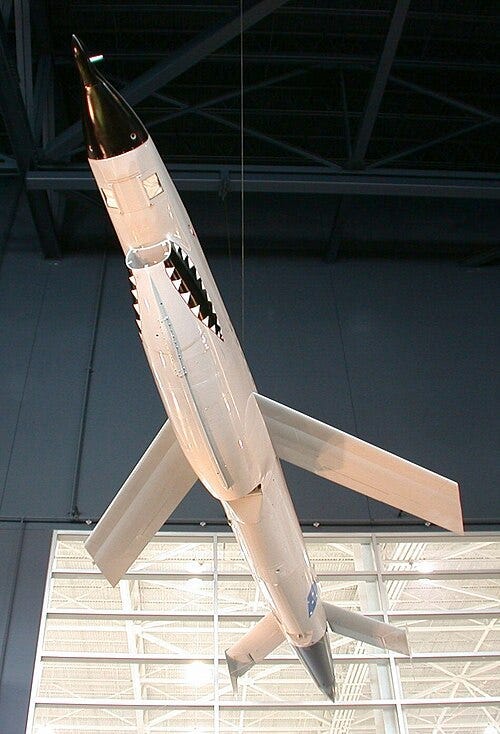

The Israeli military found an ingenious use for drones in its 1982 invasion of Lebanon, which involved hostilities against Lebanon’s ally Syria. Drones were so slow and obvious that they were easy to shoot down, so the Israelis took advantage of that apparent weakness. A huge wave of Israeli drones flew into Syrian airspace; the Syrian anti-aircraft systems activated to shoot them down. This was exactly what the Israelis wanted — the fire from the anti-aircraft batteries revealed their exact location, and the Israelis destroyed them with rocket fire.
The final shift in drone warfare took place after 9/11. American Predator drones, which became a constant presence in the skies over Afghanistan, Iraq, and other countries, finally incorporated the technology necessary to make an airborne attack drone work. They could be controlled from thousands of miles away, see targets on the ground clearly, and fire targeted weapons at the enemy. Now, remote-controlled robots could kill humans.
The Predator allowed the United States to keep its pilots safe, but the ability to kill anyone on earth over video feed without risking American lives proved tempting for American leaders. Both Republican and Democratic presidents conducted drone strikes in countries like Pakistan and Yemen, with which the United States was not at war.
American leaders didn’t seem to think about the precedent they were setting. Many drone strikes killed dangerous terrorist leaders, but they were only as accurate as the intelligence behind them. Some drone attacks killed innocent civilians, and the impunity with which the Americans killed people from the sky alienated people around the world. They normalized a world in which states could carry out extrajudicial killings across borders, without the political risk that comes from putting their own soldiers in danger.
At first, drones were high technology, available only to the most sophisticated militaries in the world. But now many countries can kill people with robots in the sky; will we live in a world in which nations can simply assassinate the people they don’t like via drone?
The recent wars in Ukraine and Iran have shown another dimension of drone warfare. As I’ve written elsewhere, the killer weapon in the Ukraine war is a cheap drone strapped to a bomb. These easy-to-build weapons have allowed the Ukrainians to hold off an invasion from a wealthier, larger foe because $500 drones can destroy Russian weapons platforms that cost millions. Iran’s strategy after being attacked by the United States and Israel has been to launch waves of $35,000 drones at enemy positions; the American Patriot missiles intercepting (most of) them cost $4 million each.
Michael Horowitz argues that warfare is entering an age of “precise mass: an era in which states and nonstate actors, great power competitors, and minor powers alike will be able to field low-cost precision weapons and sensors at scale, at both short and long ranges.”
The unmanned aerial drone has come a long way from the days when balloon bombs floated over Venice. Early drones were dumb, clunky, and ineffective. They were more quixotic curiosities than useful weapons.
But we’re entering an age where the drone will likely be a centerpiece of military strategy. They seem to be allowing smaller countries to level the playing field against traditional powers, but they are also opening up new moral questions. We seem to be ushering in a world in which swarms of unmanned killing and surveillance machines, guided by artificial rather than human intelligence, fill the skies.
The rules of war — already stretched by changes in the way that humans fight — will need to change again to regulate a world in which it’s cheap and easy to kill people using a robot in the sky.
This newsletter is free to all, but I count on the kindness of readers to keep it going. If you enjoyed reading this week’s edition, there are two ways to support my work:
You can subscribe as a free or paying member:
Or you can “buy me a coffee” by sending me a one-time or recurring payment:
Thanks for reading!
New "moral questions" indeed. One graph in the linked article about "Global Opposition to U.S.Surveillance..." is very telling: "Widespread Opposition to Drones": Israel has the highest approval rate of 65%, only 27% disapprove.
So many interesting facts about WW2, including Norma Jean Dougherty!