
Is Iran Really Different?
Or are we falling prey to old stereotypes?

No American politician can get elected to high office without indulging in some American exceptionalism. The bombastic ones trumpet the simple idea that the United States is the greatest nation in the world. The more thoughtful ones argue that the country’s history, values, and culture are unique. The message is that the United States is special, that it’s not like all the other nations.
American politicians seem to believe that Iran is exceptional, too. Though there are many countries in the world with authoritarian governments, and a handful of them with theocratic governments, Iran seems to stand alone in American (and, for that matter, Israeli) political rhetoric. Iran’s leaders, we are told, are uniquely fanatical, its politics uniquely dangerous. It can never be trusted to negotiate in good faith or to respond to the same motivations as other nations.
Important figures have said as much in recent decades. Benjamin Netanyahu calls the Iranian regime “apocalyptic” and irrational. Clinton-era CIA Director James Woolsey said that “I don’t think one can count on the common sense of the mullahs.” George W. Bush called them “evil.” And Pete Hegseth has said that “Insane regimes like Iran, obsessed with prophetic Islamist illusions, cannot possess nuclear weapons.”
Maybe they’re right, at least in part. Iran’s leaders, after all, have portrayed their own country as exceptional, positioning Iran as a lone counterweight to a decadent, imperialist West. Their maximalist rhetoric, support of terrorism and militant proxies, and cruelty toward their own people have isolated them. The current Iranian regime is dangerous and unjust.
But is Iran’s government and culture truly unlike any other in the world? Are their motives truly unintelligible to those of us in the West? Do their leaders not think rationally? These perceptions may be the result of longstanding stereotypes, because Westerners have long seen Iranians as fundamentally different and unknowable.
The oldest surviving Greek drama is Aeschylus’s *The Persians,* which tells the story of the Athenians’ victory over a Persian fleet at Salamis in 480 BCE*.* This play was one of several Athenian examinations of the Persians that circulated after the Persian Wars (the others have been lost).
It makes sense that the Athenians might want to explore their bitter enemies in fiction after a war, but there’s more going on than that. The Greeks were using the Persians as a foil to define themselves.
Aeschylus’s play is full of contrasts between what he perceives as Persian culture and Greek culture. Early in the play, the Persian queen mother, Atossa, has a conversation with the chorus that lays out the differences between the Greeks and the Persians. She asks if the Greeks are good at archery; no, the chorus says, they fight hand to hand. She asks, “Who is shepherd over them and master of their armies?” The chorus replies that “They are called no one’s slaves and subjects of no one.” The Persians scrape and bow to their queen, something the Greeks would not do, and when the Persian King Xerxes sees his fleet destroyed, he collapses into self-hatred and the Persian people let out a “cacophonous keening… all-plaintive, harsh-sounding.”
Aeschylus paints a picture of the Persians that flatters the Greeks to a Greek audience. The Persians are slavish, emotional, and fearful of direct combat, while the Greeks are free and tough.
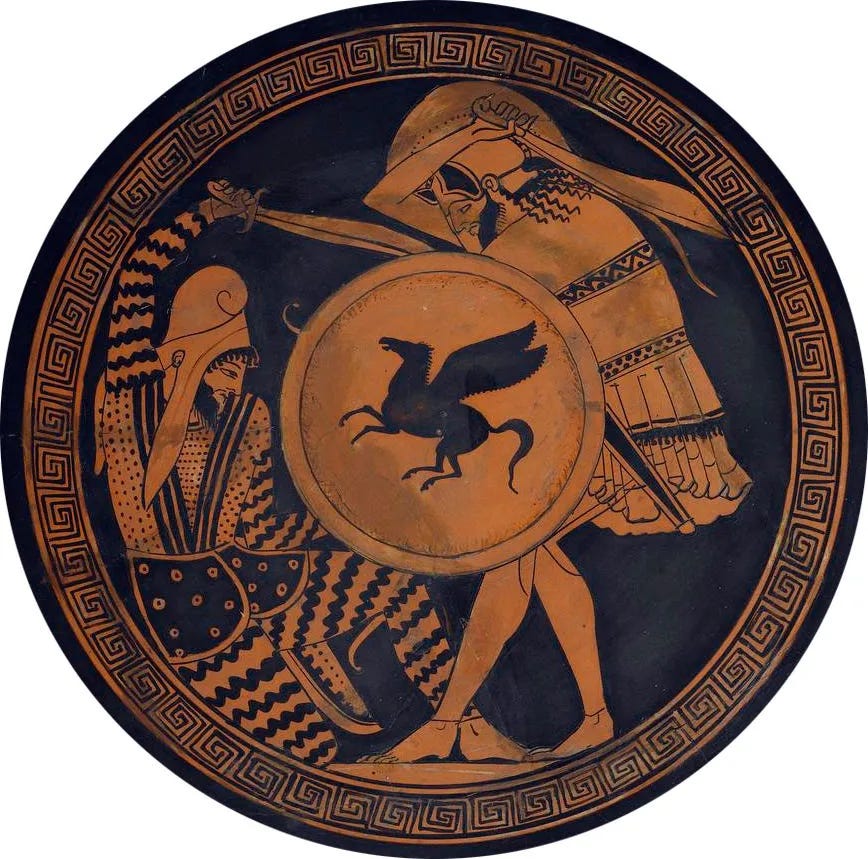
We see these stereotypes in visual art, too. Here, a dominant, simply-clad Greek warrior dominates a weaker Persian in more elaborate clothing (I wrote much more on artistic depictions here).

These cultural stereotypes made their way into philosophy, too. Aristotle, in his Politics, explains that Persians and Greeks are fundamentally different:
Those who live in a cold climate and in Europe are full of spirit, but wanting in intelligence and skill; and therefore they retain comparative freedom, but have no political organization, and are incapable of ruling over others. Whereas the natives of Asia are intelligent and inventive, but they are wanting in spirit, and therefore they are always in a state of subjection and slavery. But the Hellenic race, which is situated between them, is likewise intermediate in character, being high-spirited and also intelligent. Hence it continues free, and is the best-governed of any nation, and, if it could be formed into one state, would be able to rule the world.
According to Aristotle, different regions naturally have different types of government. Persian “barbarians” live under what would come to be called “Oriental despotism,” while Greeks are freer:
For barbarians, being more servile in character than Hellenes, and Asiatics than Europeans, do not rebel against a despotic government. Such royalties have the nature of tyrannies because the people are by nature slaves; but there is no danger of their being overthrown, for they are hereditary and legal.
Were the Greek stereotypes of Persians correct? While there may be grains of truth, the Persians would not have been able to conquer the largest empire to that point in human history without a serious military culture, and its monarchy was known in many places for justice and fairness rather than luxury and decadence.
Greek ideas about the Persians tell us more about the Greeks and the way they wanted to see themselves than they do the Persians. Historian Lloyd Llewellyn-Jones writes that this has stunted our understanding of Persian history and culture ever since:
Since the era of the Greco-Persian Wars, the Persians themselves have been at the receiving end of a historiographic smear campaign in which they have been cast as the tyrannical oppressors of the free world. The Western intellectual commitment to the promotion of its own supposed singularity and superiority has been very damaging for the study of Persia’s history.
Later Western societies built on Greek stereotypes about the Persians. They retained the Greeks’ basic contrast between a decadent, irrational, untrustworthy Persia and an honorable, logical West.
The Romans viewed the Parthian Empire, which ruled Persia from the 200s BCE to the 200s CE, and its successors, the Sassanians, as an exotic, barbaric rival to the more civilized Roman Empire. Roman chroniclers judged the signature Parthian military tactic — shooting arrows from horseback — to be an inexcusable sign of cowardice. Parthian rulers were rumored to be cruel and irrational, unlike the supposedly enlightened Romans. Sassanid kings were portrayed as “greedy, quick-tempered, rough, pompous, treacherous, and dishonest.”
Ancient ideas about the Persians (and the “East” in general) were deeply influential later on, as Renaissance and Enlightenment scholars went back to Greek and Roman sources to build their worldview. Political theorist Giovanni Botero, writing a survey of international relations in the early 1600s, portrayed Persia as a faded version of its former glory, yet still despotic and preoccupied with pomp and ritual. Jean Chardin, a French traveler, had some good things to say about Persians and their society, but his criticisms conformed to the ancient attacks on them as soft and dishonest:
Those men [Persians] are the most lavish men in the world, and the most careless of the morrow[…]. They cannot keep money and whatever riches fall to them, they waste all in a very little time…
Two opposite customs are commonly practiced by the Persians; that of praising God continually and talking of his attributes, and that of uttering curses, and obscene talk….
That’s one of the least faults of the Persians; they are besides, dissemblers, cheats, and the basest and most impudent flatterers in the world.
Montesquieu’s Persian Letters, published in 1721, was the story of a Persian man who traveled to France. Though it was mostly meant as a commentary on French society, it indulged in the usual stereotypes. Persian society was naturally despotic, and the Persian characters were notably luxurious and sensual. The work is one of the first “Orientalist” texts, depicting Persia as unchanging, unfree, irrational, and decadent. Persia, to Enlightenment-era Europeans, was both alluring and frightening, exotic and inferior.
Other fictional works from this period were both intrigued by and dismissive of Persian culture. Persia was a common setting for plays and operas, which focused on themes like the cruelty of Oriental despots and “Christian maidenhood threatened by Persian lust.”
A century later, the British arch-imperialist Lord Curzon wrote *Persia and the Persian Question,* which once again portrayed Persians as irrational. He takes swipes at the Persians’ supposed allergy to data:
Figures and facts — which are, in their very essence, an insult to the oriental imagination — are only arrived at in Persia after long and patient inquiry and by careful collation of the results of a great number of independent investigations; and I can truly say that single lines in this book have sometimes cost me hours of work and pages of correspondence.
And he portrays the society as prone to overly intense religious fundamentalism:
The more eminent mujtaheds are regarded as very holy characters. When they enter the mosque to pray, crowds gather behind them to participate in their prayers, and they spend much of their spare time in indiscriminate shouting and weeping. At the time of my visit Meshed was in one of its chronic spasms of religious excitement. The anniversaries of the martyrdom both of Hasan and of the holy Imam were being commemorated. Taziehs, or religious play, were being acted; the holy places were crowded to suffocation; and beaten tomtoms and clamoured invocations made the night hideous. Judging from the noise that he made, there must have been some particularly holy personage living near my quarters in the British Consulate; and freely did I anathematise this insufferable saint as I lay awake at night listening to his long-drawn lamentations and plaintive howls.
In the 20th century, Western portrayals of Iran bounced between two poles. Sometimes, Persia was exotic and decadent. At others, it was religiously fanatical. Always, it was assumed to be inscrutable to the West.
During the pre-revolutionary period, Iran was seen as a relatively benign but exotic and luxurious monarchy. Its leaders were unpredictable and irrational. When Prime Minister Mohammad Mossadeq nationalized Iranian oil supplies (and was then overthrown by a CIA-backed coup), American and British newspapers described him as a “madman” and “more of an actor than a statesman,” a fundamentally untrustworthy figure prone to “histrionics.” This allowed the Americans to dismiss his claims that the West was unfairly monopolizing Iran’s natural resources and that Iranians deserved to share in the profits from their country’s oil.
After the Iranian Revolution in 1979, the hostage crisis at the U.S. Embassy captivated the American press. The media focused much more on the fundamentalist nature of the new regime than on the Iranians’ anger at constant American meddling in their country’s affairs. Even the Soviets could be reasoned with, but the Iranians were a uniquely inflexible and irrational enemy. Iran — with the glowering figure of Ayatollah Ruhollah Khomeini as its avatar — was portrayed as a country incomprehensible to the Western mind, even though it had been a rather Westernized nation up until the revolution.
In recent years, we’ve seen more of these portrayals of Iran as fundamentally different from the West. Since 9/11, there’s been a constant drumbeat for war against Iran, often predicated on the idea that Iran’s leadership is simply different from other governments around the world.
They’re religious fanatics. They don’t think the same way that we do. They can’t be reasoned with. Maybe. Or perhaps we’re still under the spell of some very old stereotypes about Persians.
This newsletter is free to all, but I count on the kindness of readers to keep it going. If you enjoyed reading this week’s edition, there are two ways to support my work:
You can subscribe as a free or paying member:
Or you can “buy me a coffee” by sending me a one-time or recurring payment:
Thanks for reading!
The Jews have a word, antisemitism, to describe the pervasive stereotype against them. Is there a similar phrase to describe the anti-Iranian prejudice?